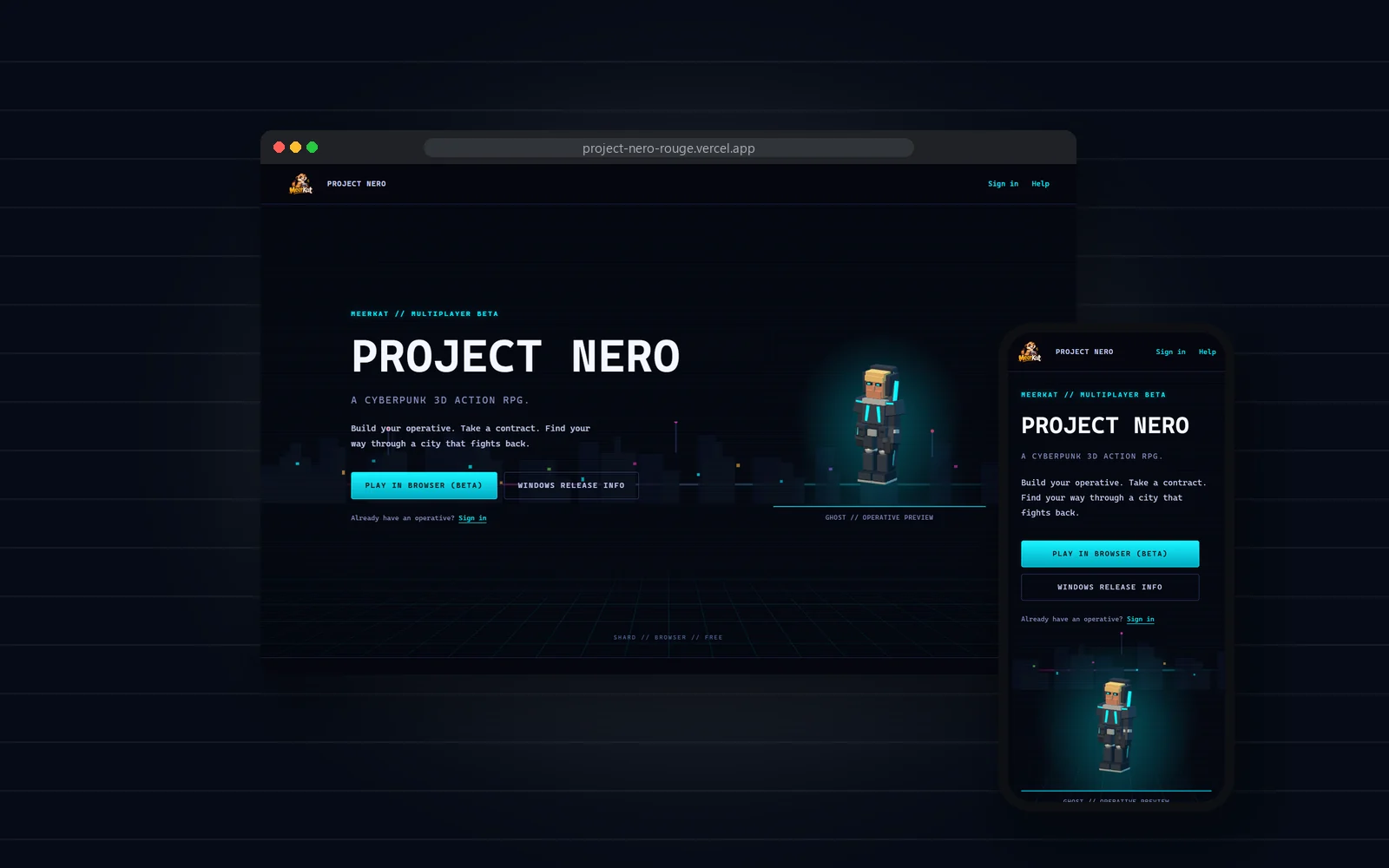
Project Nero is a cyberpunk multiplayer RPG that runs in a browser. Its current world is isometric 3D: layered city streets, industrial interiors, operatives, and creatures rendered in Three.js. The underlying simulation stays planar, so changing the presentation does not change who decides where a character can move or whether an attack lands.
I build across the client, game server, and art pipeline. React handles account and character interfaces, Phaser retains input and HUD responsibilities, Fastify serves authenticated APIs, and Colyseus manages server-authoritative zone rooms. PostgreSQL and Drizzle persist the game’s durable state.
Enemies you can outplay
Enemies telegraph attacks before resolving them. Movement, positioning, and timing give a player something to learn, while the server checks the outcome. Client prediction and reconciliation keep local movement responsive; buffered interpolation makes other characters readable between network snapshots.
Quests, NPC conversations, equipment, and faction progression give that combat a longer arc. The inventory uses an armory schematic: equipment sockets surround the operative, the bag groups items by purpose, and the inspector compares actual attributes before a change. Controls support deliberate selection as well as faster gear gestures.
Building a recognizable world
Blender-authored characters, armor, weapons, and props bring the art closer to the game’s own setting. Materials, silhouettes, held equipment, and animation need to work together in the actual renderer. Quality settings bound optional effects, and reduced motion keeps essential combat information while quieting decorative movement.
The project also supports local hosting for development and shared sessions. Accounts and persistent game state remain server responsibilities rather than browser claims.
Nero is still in active development. The current work refines movement, combat readability, inventory, and the character-art pipeline. Local browser and multiplayer checks guide those changes; broader network play, final visual acceptance, and a public release remain their own milestones.