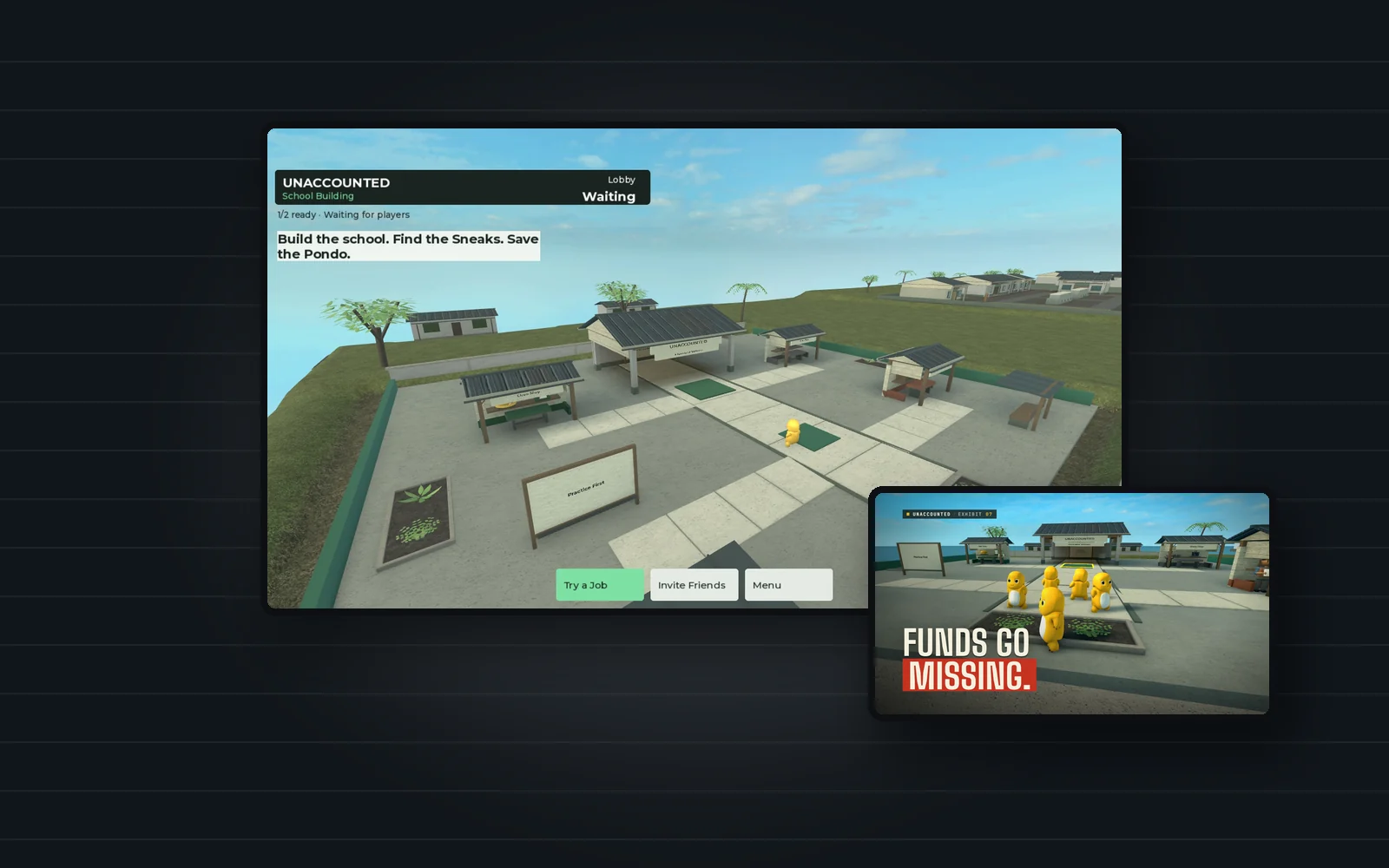

Unaccounted turns a shared construction budget into a social-deduction game. Honest players complete jobs and protect the Pondo. Secret opponents take money, hide their actions, and tempt others into deals. Everyone can see the project taking shape; understanding what happened to its budget takes more work.
I built the Roblox experience in Luau, with reviewable source files and reproducible local place snapshots. The setting draws from Philippine public-school and civic architecture: covered walkways, concrete buildings, green window grilles, and a weathered communal pavilion. Fictional officials and projects keep the game in its own world.
Work gives the conversation evidence
Players do multi-step jobs during the work phase. Published records, observed behavior, and reports create material for discussion. Hearings give players a place to explain their suspicions and vote. The game’s tension comes from comparing what somebody says with what the group can actually establish.
The server owns roles, money, progression, and voting. Private information has a defined audience. Public displays reveal scheduled information rather than becoming accidental windows into another player’s hidden state.
A place to learn before a match
The lobby introduces the rules through a bilingual orientation board, practice, and visible gathering places. English and Taglish text, enlarged-text layouts, and quick-chat presets support different ways of joining the conversation. A person can practise the job interactions without committing to a full social round.
Original Blender models and authored materials give the shops and environment more character. Decorative motion respects reduced-motion settings, while the spaces preserve usable paths and interaction targets.
Unaccounted is in private development and playtest preparation. Local multiplayer checks and rendered views establish working systems, while real-player balance, device comfort, and published-service behavior still need their own acceptance. The next useful milestone is a human session: watching where people hesitate, what evidence they understand, and whether they want another round.